The Science behind RKPP
THE SCIENCE OF PERFORMANCE
Performance isn't just a skill problem, it's a nervous system problem. Under pressure, the brain shifts how it processes attention, effort, and self-monitoring, and that shift alone can be the difference between clutch and collapse.
Why athletes choke — and why some don't. Brain imaging studies show that when the stakes go up, activity increases in the brain's control and monitoring circuits, the regions responsible for self-conscious, step-by-step oversight of movement. This heightened monitoring and emotion regulation activity has been linked to performance breakdowns under pressure. In fact, research using functional connectivity between prefrontal control regions and the motor cortex found this connection was inversely related to how likely someone was to choke under pressure, in other words, the more the "thinking brain" muscles in on a well-learned skill, the more likely that skill is to break down. PubMed CentralFrontiers
Hypnosis gives direct access to the subconscious, automatic layer of performance, the same layer flow research points to. A 2025 systematic review in the International Review of Sport and Exercise Psychology screened over 600 studies and found statistically significant associations between therapeutic hypnosis and improvements in athletic performance, injury recovery, and reduced psychological distress in athletes. Individual controlled studies back this up at the skill level: one trial found hypnosis enhanced and helped maintain self-efficacy and soccer wall-volley performance, while a broader review found hypnosis was effective for improving performance across sports, with the strongest support in basketball, golf, soccer, and badminton. Therapeutic hypnosis and sports performance: a systematic review: International Review of Sport and Exercise Psychology: Vol 0, No 0 - Get Access +2
Why we add CBT on top. Hypnosis creates rapid access to subconscious belief and response patterns. Cognitive behavioural principles reinforce that work consciously — so change isn't just felt once in a session, it's practiced and repeated until it becomes the new default response under pressure.
This isn't fringe theory. It draws on decades of neuroscience on choking and flow, and a growing, peer-reviewed body of sport psychology research into hypnosis. The honest caveat researchers themselves raise: rigorous, large-scale experimental research is still catching up to the strong practical results already being seen — which is exactly why RKPP treats this as an evidence-informed method, not a magic trick.Performance is driven by more than skill, it is governed by how the brain processes pressure, focus, and belief.
Under stress, the brain defaults to learned patterns stored in the subconscious. These patterns determine whether you stay composed, enter flow, or fall into overthinking and hesitation.
Hypnosis works by directly engaging this subconscious layer, allowing rapid access to the beliefs and responses that shape performance. Combined with cognitive behavioural principles, this approach not only rewires internal patterns but also reinforces them through conscious awareness and repetition.
This is not theory, it is supported by decades of research in neuroscience, psychology, and performance science.
A state of flow is a mental state of deep absorption where you are fully focused on a task, time seems to pass differently, self‑consciousness fades, and performance feels almost effortless; it typically occurs when there is a balance between challenge and skill. In the brain, flow is associated with reduced activity in the prefrontal cortex (sometimes called transient hypofrontality), which quiets self‑criticism and overthinking, while dopamine and norepinephrine rise, sharpening focus, motivation, and pattern recognition.
A hypnotic state shares similarities such as narrowed attention, reduced self‑monitoring, and altered time perception—but the key difference is agency: flow is self‑generated and task‑driven, whereas hypnosis involves externally guided suggestion and heightened suggestibility. In short, flow and hypnosis overlap in brain dynamics and subjective experience, but flow optimises performance and learning, while hypnosis primarily alters perception and responsiveness to suggestion.
HYPNOSIS AND THE FLOW STATE
Research in neuroscience and sports psychology has shown that hypnosis can influence the brain systems involved in focus, attention, emotional regulation and performance under pressure. Rather than being a passive or unconscious state, hypnosis is now widely understood as a state of highly focused attention and increased mental absorption — similar in many ways to the “flow state” often described by elite athletes.
Neuroimaging research has demonstrated measurable changes in brain activity during hypnosis, particularly in regions linked to concentration, self-awareness and cognitive control. Studies have shown altered activity in the anterior cingulate cortex, which is associated with focus, conflict monitoring and emotional regulation, as well as changes within the default mode network — the network linked to self-referential thinking and mental chatter. These shifts may help reduce internal distraction, quiet overthinking and improve task-focused attention.
For athletes, this is highly relevant. Performance often declines not because of physical limitations, but because attention becomes fragmented by pressure, self-doubt, fear of failure or excessive conscious control. Hypnosis and guided mental rehearsal can help athletes regulate arousal, reinforce positive performance patterns and improve access to automatic, well-trained movement under pressure.
Research in sport psychology has also explored how hypnosis may assist with:
concentration and attentional control
confidence and self-belief
reducing performance anxiety
mental recovery and relaxation
motor skill rehearsal and visualization
flow-state access and consistency under pressure
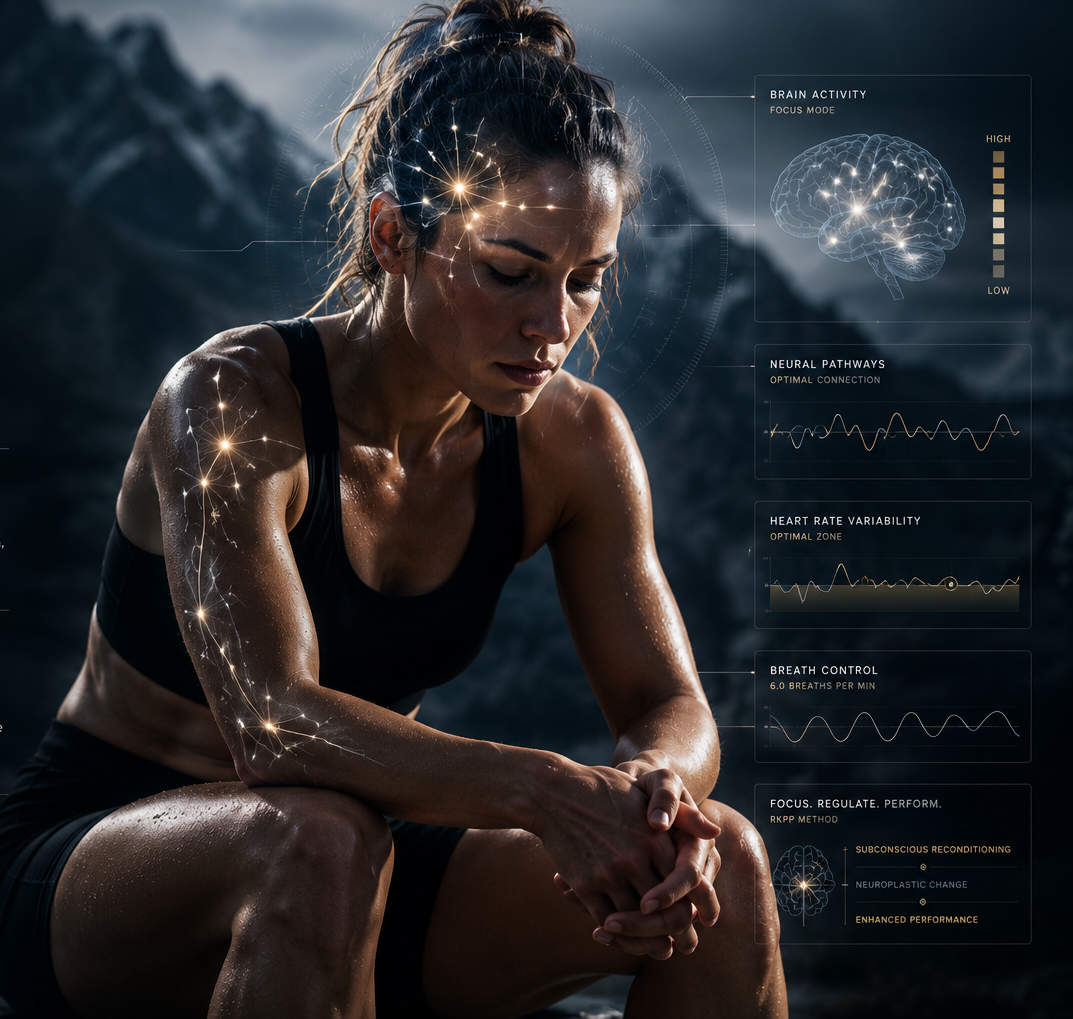
At RKPP, hypnosis is used as a science-informed mental performance tool designed to help athletes strengthen focus, regulate pressure and reinforce the mental patterns associated with peak performance.
EVIDENCE & RESEARCH
LINKS